New York Operational Improvements
NASA Science · · g5128581
New York Operational Improvements (NY Ops) The New York area airspace is notoriously complex and demanding, and is responsible for a large portion of the delays and congestion in the United States. A new research effort was initiated to examine the chronic problems associated with New York, and to develop integrated NextGen concepts that leveraged […] The post New York Operational Improvements appeared first on NASA Science .
Human Systems Integration Division Exploration Technology Directorate Exploration Technology Directorate Entry Systems and Technology Human Systems Integration Intelligent Systems NASA Advanced Supercomputing About Us Division Overview Org Chart/Personnel Awards Internships and Employment News Past Research Patents Multimedia Human-Computer Interaction Research Overview Cross-Program Integrated Data System Schedule and Planning Interface for Exploration Earth-Independent Operations Human Performance Research Overview Computational Vision Laboratory Fatigue Countermeasures Human Perception and Performance Laboratory Integration and Evaluation Research Overview Airspace Operations Laboratory Aerospace Cognitive Engineering Autonomous Vehicle Applications Human-Autonomy Teaming Aviation Safety Aviation Safety Reporting System Overview Aviation Safety Reporting System Website New York Operational Improvements (NY Ops) The New York area airspace is notoriously complex and demanding, and is responsible for a large portion of the delays and congestion in the United States. A new research effort was initiated to examine the chronic problems associated with New York, and to develop integrated NextGen concepts that leveraged existing NASA and other NextGen technologies to reduce delays, increase throughput, and/or improve trajectory efficiencies in this region.
A new research effort called New York Operational Improvements was initiated to address this issue. The research approach has been to develop and refine integrated NextGen trajectory based operations (TBO) that leverage existing NASA and other NextGen technologies to enable precise scheduling and delivery of aircraft along coordinated trajectories. These integrated tools, operations, and procedures focused on specific New York problems that can result in NAS-wide delays and congestion. The NY area presents a rich set of challenges to test the efficacy of new capabilities including excess demand, chronic delays, severe weather, and airspace complexity. Its inefficiencies are of national as well as regional importance, as it accounts for approximately 50% of the NAS-wide delays. Thus NextGen solutions that could alleviate problems in this airspace would provide significant value to stakeholders nation-wide.
The first objective of the research was to learn about the different NY bottlenecks that cause delays and limit capacity. Once the bottlenecks are identified, they can then be tackled, one at a time, by developing an integrated operational concept that addresses each specific problem before evaluating the concept in a human-in-the-loop (HITL) simulation. NY area subject-matter-experts (SMEs) were consulted to identify capacity bottlenecks in the clear weather days to determine the test area and problems that could be addressed. Through this process, a number of potential improvements were identified for the arrival and/or departure problems at the NY airports, as well as the Terminal Radar Approach Control (TRACON) and En Route airspace that feed traffic into these airports.
The problem selected for our initial investigation was that of improving the throughput and efficiency of arrivals inbound for Newark Liberty International (EWR) airport during clear weather, with the test airspace encompassing flows coming from the south through Washington Center (ZDC). An initial HITL simulation in the AOL addressing the New York airspace explored the feasibility of a NextGen TBO solution to address airspace and airport capacity limitations in and around the New York Metroplex. A concept, tools, and operational procedures for improving flight efficiency and runway throughput for EWR arrivals were developed to create a precise, dependent-runway schedule between two intersecting runways. A week-long study, conducted in August 2013, explored the feasibility of a new Optimal Profile Descent (OPD) arrival into the airspace as well as a novel application of the TMA-TM arrival scheduling tool to coordinate high volume arrival traffic to intersecting runways. In the simulation, four en route sector controllers and four TRACON controllers managed traffic inbound to EWR’s primary runway, EWR22L, and its intersecting overflow runway, EWR11. TMA-TM was used to generate independent arrival schedules for each runway, while a traffic management coordinator participant adjusted the arrival schedule so that each EWR11 followed a EWR22L aircraft. CMS tools were also provided to assist the TRACON controllers in managing the arrivals descending on OPDs.
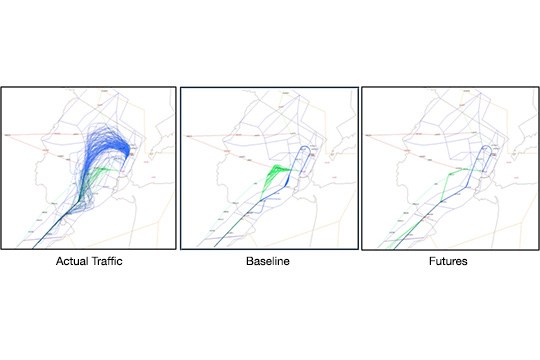
The study compared the throughput and safety of an experimental condition labelled Futures using the TMA-TM tools with dependent-runway scheduling, with a Baseline condition that did not. Figure 1 shows the lateral trajectories of the arrivals on OPDs in the Baseline and Futures conditions (5 hours of Baseline and Futures condition runs, with 190 and 198 simulation trajectories, respectively), compared to 24 continuous hours of actual operational data for arrivals from ZDC for EWR22L or EWR11 on a clear weather day (June 27, 2011, 316 aircraft trajectories). The figure illustrates that the OPD RNAV trajectories used in the study resulted in fewer lateral path deviations than the trajectories from the operational data.
The post New York Operational Improvements appeared first on NASA Science .