Ishanguly Ishangulyev – An Artist of Diverse Styles and Enduring Appeal
Turkmenistan RSS Feed ·
People’s Artist of Turkmenistan Ishanguly Ishangulyev constantly surprises viewers with his work. At one time, his main subject was the landscape, but not an urban or rural landscape — rather, the desert.
People’s Artist of Turkmenistan Ishanguly Ishangulyev constantly surprises viewers with his work. At one time, his main subject was the landscape, but not an urban or rural landscape — rather, the desert. The master did not simply depict endless golden dunes; he gave them the contours of a beautiful woman. Perhaps she was the mistress of the desert, perhaps a mirage, or perhaps the artist’s muse. Whatever it was, the landscape looked beautiful and original.
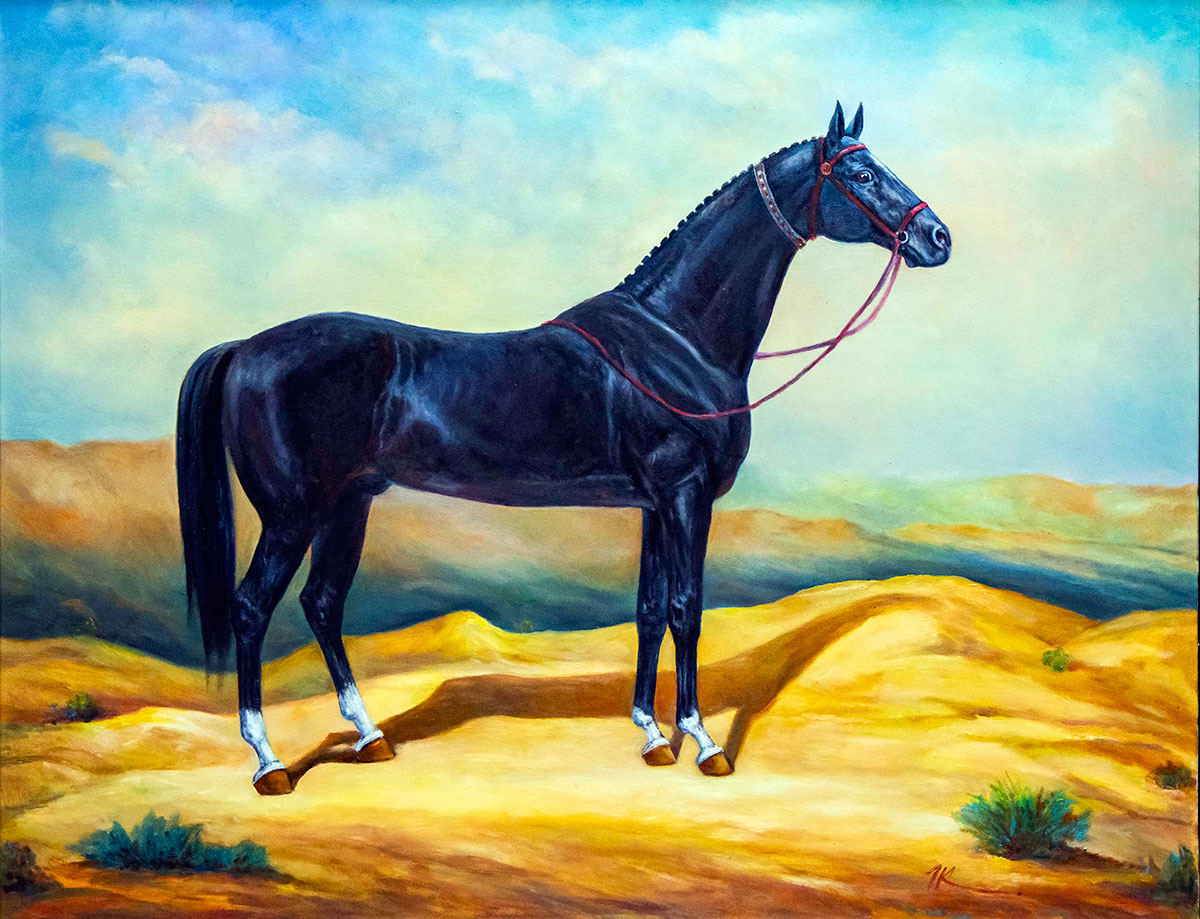
Later, the artist became fascinated by famous horses. Ishanguly can talk for hours about the Akhal-Teke horses depicted in his paintings. For example, the black horse named Absent was a champion of the 1960 Olympic Games and a multiple Olympic medalist. And the white horse named Arab was his father, who, according to one version, became famous at the opening of the Victory Parade on Red Square, prancing under the saddle of the renowned rider — Marshal Georgy Zhukov.
And in this painting, there is the horse Pyyada, a sculpture of which stands at the entrance to the Ashgabat Equestrian Sports Complex. The artist immediately begins telling us about what made this Akhal-Teke horse famous.
“Every Turkmen carries the image of a horse in their soul at the genetic level,” says Ishanguly, “so whatever I may be engaged in, from time to time I return to this subject.”
Ishanguly Ishangulyev is a very versatile artist. He brings to his canvases legends handed down by his ancestors and sometimes even creates legends of his own, which he does especially well in the abstract style. Usually, this involves a textured layering of paints, predominantly in burgundy shades, reminiscent of the colors of a Turkmen carpet. Moreover, the subject of the painting does not immediately reveal itself to the viewer: before grasping the story of the work, one has to carefully examine the intricate lines depicting various objects.
One of the master’s most expressive works is the painting “Mejnun.” Executed in a romantic-symbolic style, it conveys the suffering of a young man in love, for whom the world has split into two halves because he cannot be with his beloved Leyli. This canvas is rightly considered one of the finest works created on this subject.
Taking part in group and solo exhibitions, as well as traveling on creative assignments, Ishanguly Ishangulyev has visited India, Türkiye, and China. Here is an interesting fact: before leaving for India, the master painted an easel work dedicated to Bayram Han, depicting this outstanding statesman of Turkmen origin as an important nobleman. After returning from his trip, he once again dedicated a painting to Bayram Han, but this time portrayed him as a poet and thinker.
The theme of women is one of the main subjects in the work of the People’s Artist. Portraits of Indian women occupy a prominent place in Ishanguly Ishangulyev’s collection. The Turkmen artist has succeeded remarkably well in conveying their inner world, charm, modesty, and tenderness.
Applying the principles of Cubism, he achieved a high degree of artistic expression in the “Gelin” series. When viewing this cycle of works, in which one painting is more beautiful than the next, one is tempted to call the artist a singer of the beauty of Turkmen women. Characteristically, the colors of the large areas of color on the canvases coincide with the favorite colors in the clothing of Ishanguly’s compatriots — this, too, can be seen as the master’s admiration for their refined taste.
Interestingly, the artist uses braid in some of his works. This innovative element and bold creative solution once again emphasize the national character of the heroines depicted in his paintings.
“Rodoguna,” “Parthian Horses,” “Silk Road,” “Caravan,” “The Wisdom of Bayram Han,” “Moon Mountains,” “Cappadocia,” “Reflections,” “Three Daughters-in-Law,” “Melody” — in these and many other remarkable paintings, realism, symbolism, abstraction, and Cubism coexist harmoniously under the brush of Ishanguly Ishangulyev. Perhaps this diversity in his work can be explained by the fact that Ishanguly studied at the I. E. Grabar All-Russian Art Research and Restoration Center, where he thoroughly mastered the art of restoration. The profession of a restorer required him to immerse himself in the artistic manner of the authors and restore works in such a way that the restorer’s own brushstrokes remained imperceptible. Ishanguly Ishangulyev did not become a restorer; instead, he immediately revealed himself as an original and promising artist. The valuable skills he acquired at the center help him create new characters for his canvases in any style.
We look forward with interest to new works by Ishanguly Ishangulyev, believing that he will surprise us with his talent more than once again.