AI Car Dealer Scams Are Infesting Facebook Marketplace—and They’re Working
The Drive ·
Fake photos, fake voices, and a $36,000 deal for a Toyota 4Runner that never existed shows how AI is supercharging Marketplace scams. The post AI Car Dealer Scams Are Infesting Facebook Marketplace—and They’re Working appeared first on The Drive .
Internet scams are part and parcel of the online experience. If you use the World Wide Web, you’re sure to come across someone who wants your money, your identity, or heck, probably both. Some have been around long enough to spot—most of us know by now that a Nigerian prince doesn’t need money orders or Apple gift cards—but others are fresh enough to fake out even diligent shoppers . In the case of Wil Matthews, who recently purchased a Toyota 4Runner that never existed with financing from a Tier 1 auto lender, the scheme was especially devious.
These shifty scams that cleverly employ artificial intelligence are running rampant on Facebook Marketplace, where big-ticket items (like cars) are bought and sold every minute. Matthews has seen dozens of ’em, even before he was duped earlier this summer. That’s partially why he was so shocked to find the 4×4 he’d agreed to pay roughly $36,000 for was imaginary.
The TRD Pro model was realistically priced, so that didn’t raise any red flags as Matthews clicked through photos of the rig. To Matthews, who is a professional photographer himself, it just looked like a normal car posed in a parking lot. He even checked to make sure that the seller—named as Route 519 Motor in Donna, Texas—was legit. And, technically, Route 519 Motor Company is. But the scammers had cloned the company almost to a T, even producing window stickers, purchase orders, and a dealer license certificate that looked real but simply dropped “Company” from the end of the name.
With little reason to doubt that the listing was fake, Matthews arranged financing through one of the nation’s largest credit firms. They also vetted the listing, and if you Google the VIN, it comes back as legit. The bank promptly transferred $36,240 to the LLC’s account, despite it only being founded a few months prior. Up to this point, Matthews still had no indication the deal was a sham.
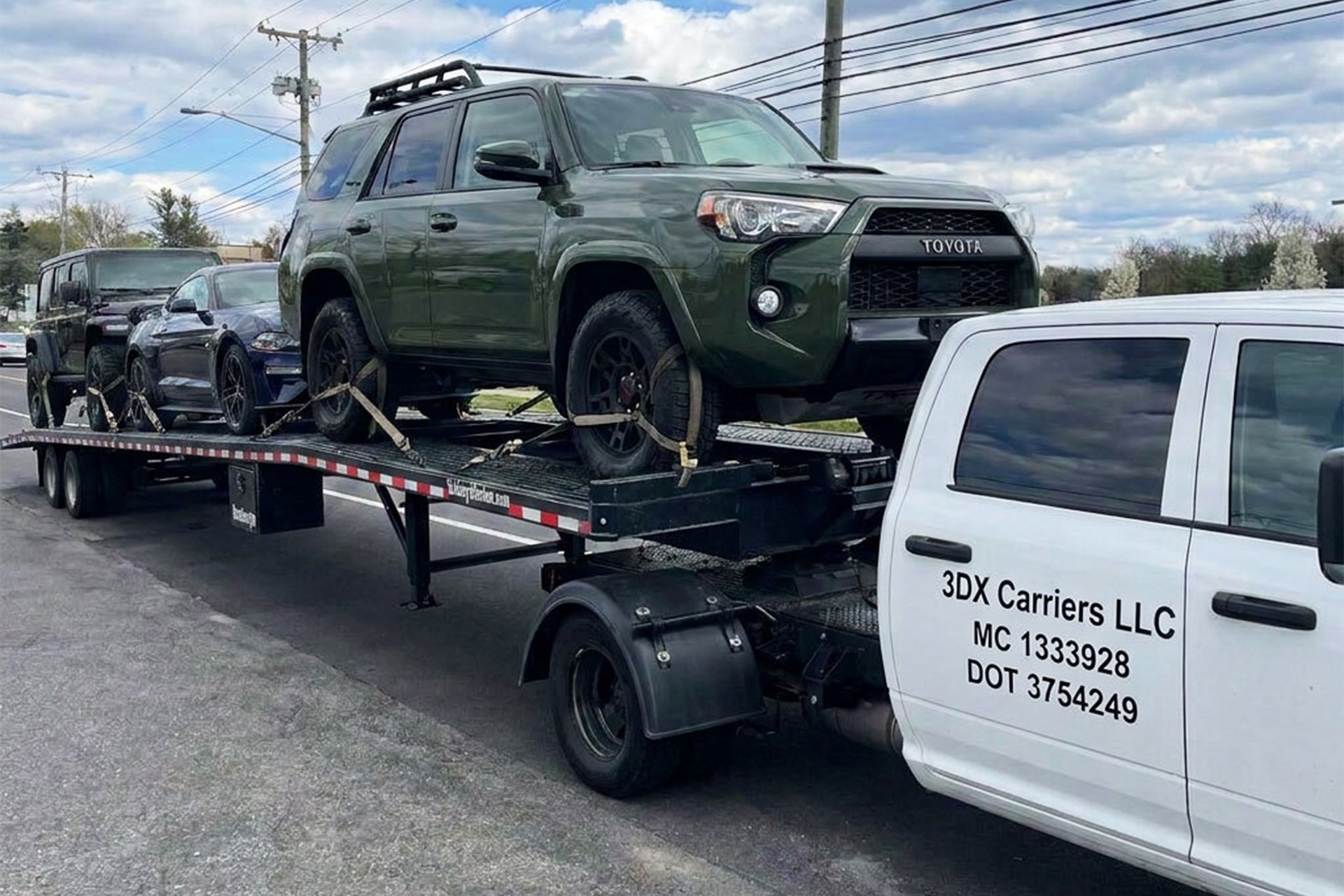
The cybercriminals behind the cloned dealer identity even provided Matthews with a link to a spoofed live GPS tracking portal. He watched as the webpage showed his make-believe Toyota going from Texas to his home in California. They then sent him a photo depicting the car on a transport trailer, and on the tow vehicle’s back door, a vinyl decal read “3DX Carriers LLC” with actual motor carrier and DOT numbers. It wasn’t until the tracking site said the 4Runner was delivered and Matthews was greeted by an empty street in front of his home that he knew something was up.
Rather than those identifying MC and DOT numbers linking the delivery to 3DX Carriers, DOT records show them belonging to a V&S Group. Matthews began searching for more info on V&S Group, only to find two fraudulent addresses—one of which was in Wyoming. That fake address was also tied to multiple other fictitious carriers.
The web only got more tangled when Meta’s page transparency metrics revealed that a user in Moldova created and actively managed the phony dealer’s Facebook account. To mask this, they worked in tandem with a domestic shell company registered in Tennessee. The scammers further obscured their identities by using a VoIP phone switchboard, allowing them to answer calls from any device with an internet connection, while the supposed delivery driver spoke through a computer-altered voice synthesizer. These guys were tricky, and seemingly thought of everything.
Fortunately, Matthews was incredibly thorough in his documentation of the transaction, and he contacted his lender immediately when the vehicle wasn’t delivered as expected. He invoked the FTC Holder Rule, which transferred liability to the bank, and he was ultimately allowed out of his contract when they waived the loan. If a professional photographer with a trained eye can fall for such a scam, why assume that you’re any better off? Odds are, you’re not, and precious few people would be able to prepare stacks of paperwork, excruciating and comprehensive in detail, should they find themselves victimized.
These AI-assisted scams are everywhere. Matthews sent me a handful of seemingly fake listings one afternoon, and he found many of them in a single sitting. Exactly how these false dealers decide which vehicles to recreate and list is unclear, but given how aggressive Facebook’s algorithm is, you’re just as likely to encounter a fake as Matthews was. Making matters worse, the scammers paid to boost the 4Runner listing in question, so it was pushed out to even more unwitting potential buyers. Matthews tells me that’s often the case with the fakes he spots nowadays.
While it’s difficult to verify fakes at a glance, Matthews’ case is not an anomaly. I’ve reached out to Meta for comment, and I’ll update this story if a company spokesperson responds. The tech juggernaut, which owns Facebook as well as Instagram, Threads, and WhatsApp, already has its hands full with AI misuse across all of its platforms. Global activist groups and governments are pressuring Meta to more effectively moderate AI ads as well as deepfakes, many of which wrongfully harm individuals’ reputations.
As this instance proves, there’s a lot at risk if these fake dealers are allowed to spread like wildfire across Facebook Marketplace. The for-sale platform has become the go-to for literally billions of dollars in e-commerce, and while not all transactions are as large as a Toyota 4Runner, many of them are. Consumers are at a disadvantage here, without a doubt, and right now, the cries for recourse are largely going unanswered.
Got a tip or question for the author? Contact them directly: caleb@thedrive.com
The post AI Car Dealer Scams Are Infesting Facebook Marketplace—and They’re Working appeared first on The Drive .