EBOLA BUNDIBUGYO VIRUS DISEASE OUTBREAK Democratic Republic of the Congo | Uganda Weekly External Situation Report 19, Data as of 20 September 2026
WHO | Regional Office for Africa - Making People Healthier ·
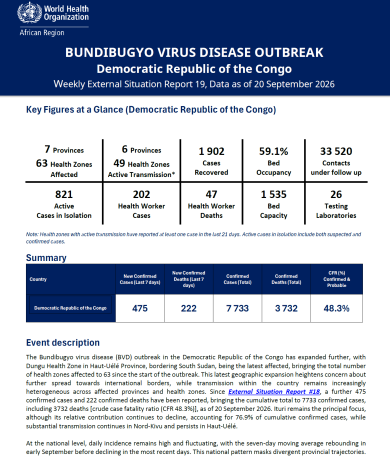
EBOLA BUNDIBUGYO VIRUS DISEASE OUTBREAK Democratic Republic of the Congo | Uganda Weekly External Situation Report 19, Data as of 20 September 2026 orlunwop@who.int Tue, 22/09/2026 - 15:14 Event description The Bundibugyo virus disease (BVD) outbreak in the Democratic Republic of the Congo has expanded further, with Dungu Health Zone in Haut-Uélé Province, bordering South Sudan, being the latest affected, bringing the total number of health zones affected to 63 since the start of the outbreak. This latest geographic expansion heightens concern about further spread towards international borders, while transmission within the country remains increasingly heterogeneous across affected provinces and health zones. Since External Situation Report #18, a further 475 confirmed cases and 222 confirmed deaths have been reported, bringing the cumulative total to 7733 confirmed cases, including 3732 deaths [crude case fatality ratio (CFR 48.3%)], as of 20 September 2026. Ituri remains the principal focus, although its relative contribution continues to decline, accounting for 76.9% of cumulative confirmed cases, while substantial transmission continues in Nord-Kivu and persists in Haut-Uélé. At the national level, daily incidence remains high and fluctuating, with the seven-day moving average rebounding in early September before declining in the most recent days. This national pattern masks divergent provincial trajectories. Ituri continues a gradual decline from its late-July peak but remains at a high level, while Nord-Kivu experienced a marked increase, reaching its highest incidence in mid-September, followed by an apparent decline in recent days. Transmission in Haut-Uélé remains sustained but below its August peak, while Tshopo shows renewed activity from a low baseline. Bas-Uélé continues to report sporadic transmission, with no recent transmission evident in Sud-Kivu. Overall, the epidemic remains geographically heterogeneous, with recent declines in the principal transmission areas occurring alongside persistent low-level transmission and continued geographic expansion to new areas. Weekly External Situation Report 19, Data as of 20 September 2026 Related Health Topics Ebola Disease
EBOLA BUNDIBUGYO VIRUS DISEASE OUTBREAK Democratic Republic of the Congo | Uganda Weekly External Situation Report 19, Data as of 20 September 2026 orlunwop@who.int Tue, 22/09/2026 - 15:14 Event description The Bundibugyo virus disease (BVD) outbreak in the Democratic Republic of the Congo has expanded further, with Dungu Health Zone in Haut-Uélé Province, bordering South Sudan, being the latest affected, bringing the total number of health zones affected to 63 since the start of the outbreak. This latest geographic expansion heightens concern about further spread towards international borders, while transmission within the country remains increasingly heterogeneous across affected provinces and health zones. Since External Situation Report #18, a further 475 confirmed cases and 222 confirmed deaths have been reported, bringing the cumulative total to 7733 confirmed cases, including 3732 deaths [crude case fatality ratio (CFR 48.3%)], as of 20 September 2026. Ituri remains the principal focus, although its relative contribution continues to decline, accounting for 76.9% of cumulative confirmed cases, while substantial transmission continues in Nord-Kivu and persists in Haut-Uélé. At the national level, daily incidence remains high and fluctuating, with the seven-day moving average rebounding in early September before declining in the most recent days. This national pattern masks divergent provincial trajectories. Ituri continues a gradual decline from its late-July peak but remains at a high level, while Nord-Kivu experienced a marked increase, reaching its highest incidence in mid-September, followed by an apparent decline in recent days. Transmission in Haut-Uélé remains sustained but below its August peak, while Tshopo shows renewed activity from a low baseline. Bas-Uélé continues to report sporadic transmission, with no recent transmission evident in Sud-Kivu. Overall, the epidemic remains geographically heterogeneous, with recent declines in the principal transmission areas occurring alongside persistent low-level transmission and continued geographic expansion to new areas. Weekly External Situation Report 19, Data as of 20 September 2026 Related Health Topics Ebola Disease
Источник: WHO | Regional Office for Africa - Making People Healthier