GASA Mexico and the Ministry of Foreign Affairs Hold Working Meeting Ahead of the Chapter’s Annual Forum, “From Coalition to Action”
Blog ·
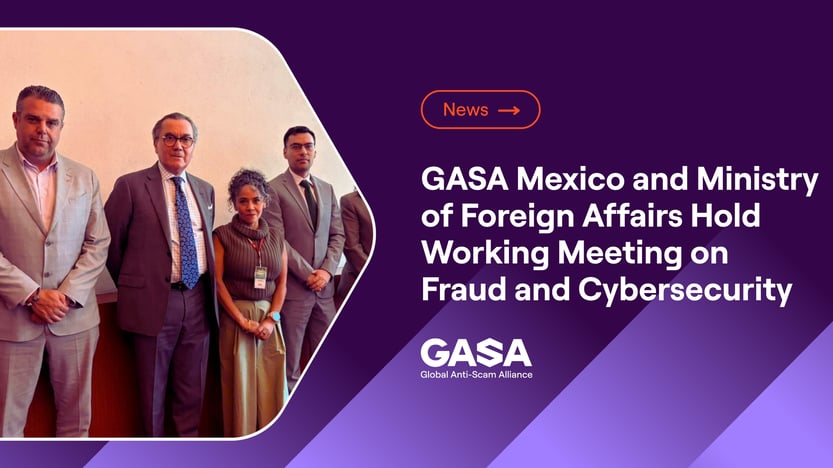
Participants included Ambassador Ulises Canchola Gutiérrez, Special Ambassador for Emerging Technologies; Ricardo Ballesteros Cuevas, Director of Multilateral Analysis and Dialogue; Alejandra Lara Alvarado, Vice President of Security Solutions for North LAC at Mastercard; Fabián Goncalves Ambielle, Vice President of Fraud Management for International Banking and GTB at Scotiabank; and Sissi De La Peña, Director of GASA’s Mexico Chapter.
The discussion focused on the challenges Mexico and Latin America face at the intersection of emerging technologies, fraud, and cybersecurity . These include the lack of a common taxonomy, the convergence of the fraud and cybersecurity agendas, information sharing among institutions, the role of education, and the scope of prevention efforts.
Building on the conclusions of the UN Global Fraud Summit held in Vienna in March this year , as well as the public-private partnership (PPP) agreement that emerged from it, taxonomy was a central part of the discussion. Today, the terms scam, fraud, and cybercrime refer to different phenomena, and each institution classifies and reports them according to its own criteria. As a result, the true scale of the problem remains difficult to determine. Standardizing terminology would help align reporting criteria and establish a shared knowledge base on which to build.
In this context, the meeting identified the institutional profiles whose participation will be important to the Forum: international organizations specializing in cooperation and financial crime; financial intelligence and banking supervisory authorities; law enforcement and public security agencies; consumer protection and financial services user protection bodies; digital transformation authorities; and telecommunications regulators.
The cybersecurity and fraud prevention agendas were discussed as two dimensions of the same effort. Participants noted that existing response mechanisms need greater visibility, both in cybersecurity and in bringing fraud cases to light. They also agreed on the need to establish a network that enables information sharing in the form of data intelligence , based on timely and simultaneous coordination.
Preparing for the convergence expected next year as new layers of artificial intelligence emerge was also identified as a priority. Participants expressed their willingness to better align the pace of technological adoption, public uptake, and policy response. Technology, education, and collaboration were identified as interconnected components of the same effort.
Sign up for the GASA newsletter to receive regular updates on scam prevention, research, and best practices.