Batteries that safely break down in the GI tract could improve ingestible devices
MIT News ·
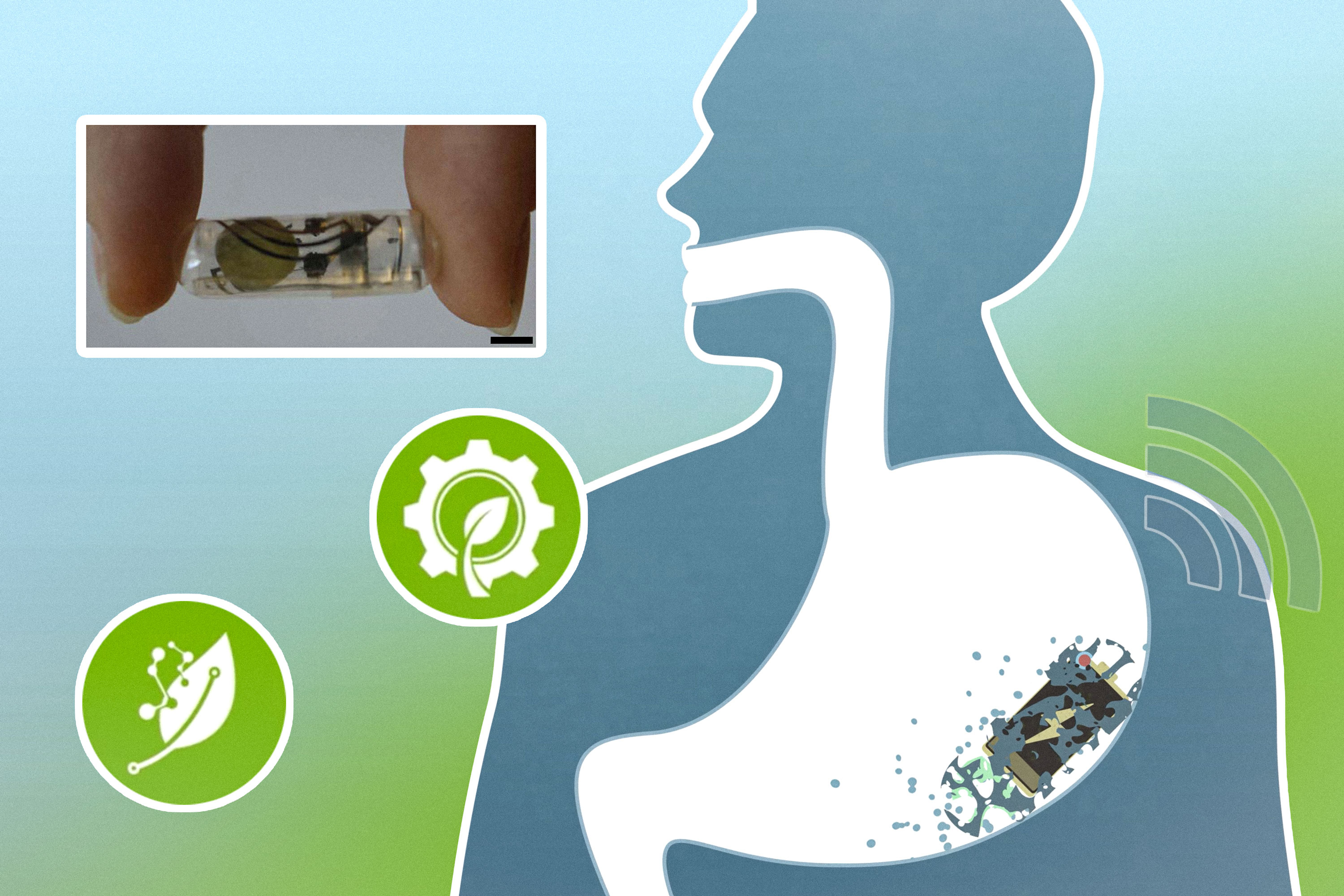
Made from “bioresorbable” materials, the new batteries could power capsules for drug delivery, sensing, and other applications.
Using materials safe for human consumption, MIT researchers have created tiny batteries that could be used to power ingestible electronic devices. Such batteries could make the devices safer for patients and minimize the environmental impact of the batteries after they are excreted.
In a new study, the researchers showed that the batteries, which generate 1.84 volts, could power two different types of devices: an RFID tag that can transmit from the stomach, and a capsule that produces a small electrical current that stimulates production of ghrelin, the hunger hormone.
This type of battery, which contains electrodes made from magnesium and molybdenum trioxide, could also be deployed in other ingestible devices for sensing or therapeutic applications, the researchers say.
“For many of the systems we’re developing, we need power, and we power the system through different ways,” says Giovanni Traverso, a professor of mechanical engineering at MIT, a gastroenterologist at Brigham and Women’s Hospital, and an associate member of the Broad Institute of MIT and Harvard. “Often, we use batteries, so the question here was: Could we develop a battery that was bioresorbable, and then apply that across a range of application areas?”
Traverso is the senior author of the paper, which appears today in Nature Chemical Engineering . Former MIT postdoc Mehmet Girayhan Say is the paper’s lead author.
Biocompatible batteries
Over the past decade, Traverso and his collaborators have developed ingestible capsules that can monitor vital signs , deliver a variety of drugs , and detect opioid overdoses .
Not all of these devices require a power source. For those that do, the researchers have powered the devices from an external source that wirelessly transmits power, harvested power from the GI tract, or used small coin batteries. However, those batteries, which usually contain lithium, silver oxide, or other metals, could pose a safety risk if the battery’s protective coating was damaged while traveling through the GI tract.
To create a safer battery and allow the systems to be fully self-contained with no external power needed, the researchers turned to metals that can act as electrodes but are safe for human consumption in small amounts — magnesium and molybdenum trioxide.
“Those materials are known to be relatively safe. That was the biggest driver, thinking about materials that can be tolerated by humans,” Traverso says.
The researchers used magnesium to create the battery’s anode and molybdenum trioxide for the cathode. The battery also contains an ionic liquid gel electrolyte, and the entire system is bioresorbable, meaning that it can be fully broken down and absorbed by the body. The researchers designed two different versions of the battery that could be used for different applications —a disc 7.5 millimeters in diameter and a rectangular bar 24 millimeters long.
To test how the batteries would behave in the GI tract, the researchers first exposed them to a highly acidic solution similar to gastric juice. They found that the batteries function normally for about three days, then their performance begins to slowly decline. Within a few weeks, they break down completely.
The researchers then incorporated the rectangular battery into a degradable device they first reported in 2023, which is designed to deliver a small electrical current to the lining of the stomach. In their earlier work, Traverso’s lab showed that this jolt could stimulate endocrine cells in the stomach to produce ghrelin.
Stimulating ghrelin secretion could prove useful for treating diseases that involve nausea or loss of appetite, such as cachexia (loss of body mass that can occur in patients with cancer or other chronic diseases).
The initial version of that device was powered by two silver oxide coin batteries, similar to those used in FDA-approved ingestible devices. By replacing those with the new magnesium-molybdenum oxide batteries, the researchers made nearly the entire device — with the exception of a printed circuit board — bioresorbable. Any components that aren’t absorbed can be passed through the GI tract and excreted.
In the new study, the researchers showed that new battery was strong enough to generate continuous electrical stimulation for up to three days. Tests in animals showed that 20 minutes of stimulation within the stomach could boost ghrelin levels by about 50 percent.
“What makes this work exciting is that we were able to show that a bioresorbable battery is not just a concept. It can actually power clinically relevant functions inside the gastrointestinal tract and then simply dissolve,” Say says.
Battery-powered communication
The researchers then incorporated the battery into a RFID device, which they designed to help patients adhere to their medication schedules. This capsule can transmit its location from within the GI tract via a bioresorbable RFID tag made from molybdenum and cellulose.
An earlier RFID system, known as SAFARI and reported by Traverso’s lab in January, used passive RFID tags, powered by harvested energy, which limits the communication range.
In the new study, tests in animals showed that RFID tags could be effectively powered by a disc-shaped bioresorbable battery. With the new battery, the device could transmit continuously from the GI tract, and with a longer range (up to 1.5 meters).
The researchers are now planning a clinical trial for the SAFARI system, which they expect will begin in about two years. Such systems could not only be safer for patients, but also would reduce the environmental impact of batteries that would eventually be excreted into the sewage system.
“The benefits are twofold: one, the ability to be bioresorbable, but also the potential to minimize environmental impact because the materials will be degraded in the environment as well,” Traverso says.
The research was funded by Novo Nordisk, the Karl van Tassel Career Development Professorship, MIT’s Department of Mechanical Engineering, the Brigham and Women’s Hospital Division of Gastroenterology, and the U.S. Advanced Research Projects Agency for Health (ARPA-H).